
Collaborations
Creating Cartoons in a Time of Chaos

I’m reading What It Is by Lynda Barry because another writer on Substack listed it as his number one most influential writing book in a list of seven favorites. I am embarrassed that I can’t remember his name or I would certainly put it here. I’m not a regular reader of his, but simply saw that he had a list of writing books. My apologies should he somehow stumble across this post, although it isn’t likely.
I didn’t realize Lynda Barry had published a book on writing, but her book, Making Comics practically saved my life during the Covid Years, 2020-2021. In those pre-vaccine days when we were desperate souls on a whirling Titanic being sucked into a black hole in the deepest part of the ocean, (Do I mix my metaphors here? Lynda Barry would be proud.) my best friend and I read Making Comics together. Page by page, prompt by prompt, that book helped us, not only survive Covid, but reminded us to love the lives we had. Drawing comics stretched our creativity and kept us smiling, while we waited along with the rest of the world for a vaccine and better days to return.
Lynda Barry, literally, drew us into a world populated by both her, and our own, absurd creations. We became heroes in those worlds. Complete with flowing capes, strange caricatures with spiked up hair and sprongs of curls emerged to save us from ourselves. On index cards and blank sheets, in journals and spiral bound notebooks, we had super abilities and could do everything we ever dreamed of doing.
In those early Covid days, so often painfully isolated from friends and family, when all of us marked time by the daily count of people killed by the virus flashing mercilessly across our tv screens, Jane and I took Lynda Barry up on her offer to alter time. Although the drawings were often abbreviated by the timer buzzing our phones, we found the hours flew as we kindergartened show and tell. The conversations that followed our efforts massaged our hearts and soothed our troubled souls. In Comic Land, laughter sparked a fire on the grayest day. In the no-time of cartoons, we found space to live and breathe. In the well-oxygenated groves of Graceland, we nurtured the intimacy that comes from creating alongside a dear friend.
Despite the short bursts Barry gave us in which to create, or perhaps because of the limitations, we entered a time warp so profound we often forgot lunch, only to look up and find evening dropping its shades over the windows. We drew comics at high speed, with little time to think. We had a minute to make our characters into a fruit or vegetable. We got three minutes for an action scene. Occasionally, in a burst of generosity or complexity, LB would give us five minutes to make four panels. Then there was the 30-second horse. So where did the time go?
The morbidity of our world, the constant reminder that we walk always on the thin ice of mortality, made us hunger for creation and productivity. We were busy making comics. We found out we could be funny and interesting and profound all at once, and in the midst of a worldwide plague. While we made meaning cloaked in capes, people died. There was nothing more we could do, so we drew and drew. Isn’t that how life works? One is created as another dies, all at once and without our permission.
Meanwhile, back at the ranch, Jane and I performed superhuman feats and peopled our aloneness with interesting characters we pulled from thin air like magicians or sorcerers, or witches. Greater even than our best comics, we created joy in the midst of loss and despair.
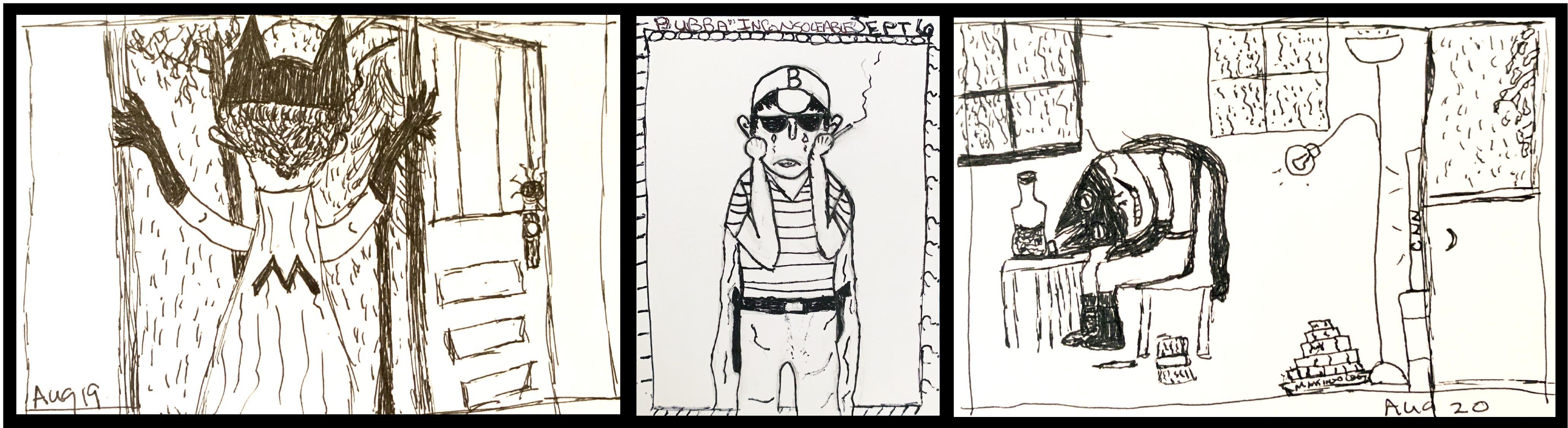
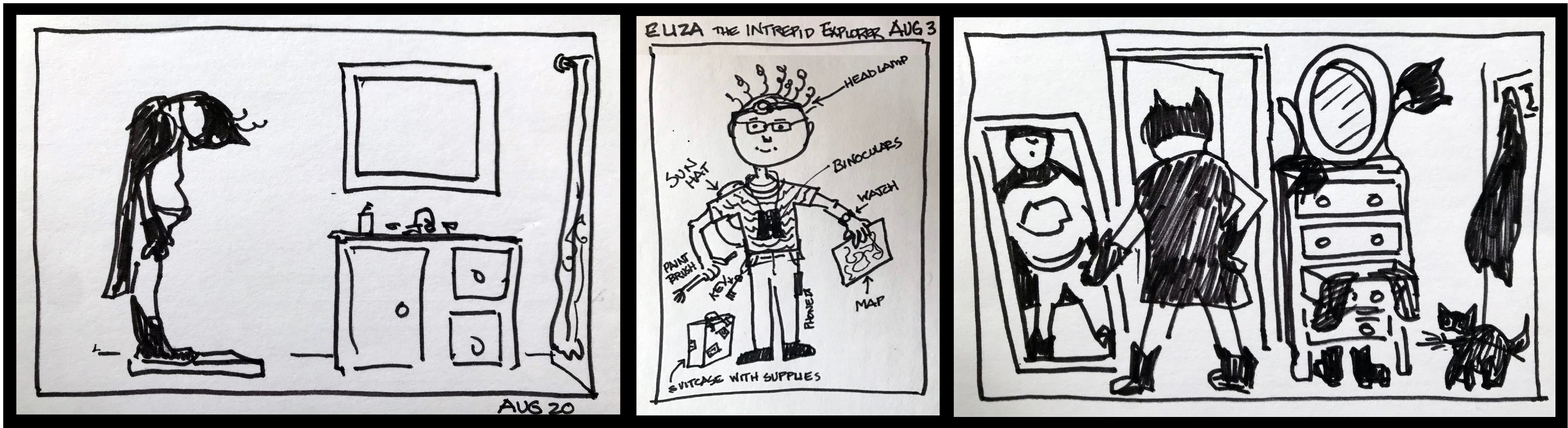
At that time, I lived over an hour from Asheville. I owned a tiny house on a small farm in the shadow of Mount Mitchell. Jane left her pod in Asheville to join mine in Busick for a day every week. Our pod consisted of me, Jane, and Lynda Barry (her book, to be exact, but I felt her there, smoking and calling, “TIME!”) The two of us sat side by side on a sofa in my studio house, masks on at first, one curly head and one spiky, bent over drawing pads, index cards, and sheets of paper penciled four square. With #2 pencils, but mostly pen and ink, we breathed life into Eliza, Intrepid Explorer (Jane), and Bubba Hoodoo(Me). These two, so like us and yet different, cracked us up time and again. To our amazement, they just as often revealed deeply personal insights into who we are as human beings, flawed but mighty, living in a deeply flawed and mighty beautiful world.
Consider how hard it is for a novice illustrator to find comfort drawing and coloring while sitting next to a famous, fabulous watercolor artist, one from a family of artists named Voorhees. Lynda Barry prepares you for this moment, the one where you realize you have no artistic talent. The minute I thought, Wait a minute. I’m a poet, a wordsmith. I can’t fucking draw.
“Hey!” Lynda hollers from the pages of her book. “You’re drawing cartoons. They’re supposed to be weird. They’re supposed to be “outside the lines” of “reality.”
Believe me, nobody else—no artist and no AI—has ever created characters like Bubba or Eliza. Also, and what a relief for the writer, you can make bubbles filled with words. Cartoons can have captions. I was delighted to find how few of mine needed my words. They were self-explanatory. In my mind, though, I wrote entire screenplays starring Bubba and Eliza.
I loved those months Jane and I occupied Cartoon Land together. Although we observe our surroundings differently, whether it be object, room, or living being we share the desire to re-create them as authentically as possible. Jane paints mountains, seashores, sheep and goats so real you can drive into her landscapes, reach out a hand and stroke the wooly back or scratch a bony head between the horns . Her work with light and shadow are incredible, really. She renders depth of perception, making a painting that lives and breathes on the canvas. I know the title of a painting, even a landscape, almost as soon as I see the work.
The world I portray on a blank page has weird, wonky lines that don’t follow any set rules, like gravity or the way a door opens. Often enough, this is how I see life. I’m merely interpreting what I observe to be true. The line of the ceiling I’ve drawn would narrow the room to a tiny box if it continued, but it doesn’t. So who cares? I may not notice my errors for days, and usually when someone calls my attention to it. Neither Lynda Barry or Jane Voorhees care one whit. “I love your wonky style,” Jane says. “Besides, it’s cartoons. Maybe consistency counts for something with your characters, but that simply requires repeated practice. You have to draw them over and over. Or just give them identifiers, like Bubba’s cigarette and dark shades. Anyway, the world’s going crazy. So draw it that way.”
You got this, I think.
I am spoiled. Feeling insecure about my drawing and painting ability, I draw and color almost exclusively with Jane, who is the best teacher, as well as one of the most easy-going people in the world. She is the human example of the word patience. I’m not sure how she has remained my bestie for so long now. I got lucky as she has been ponying my high-strung writing ass along for 30 years, and I don’t think we’ll ever quit collaborating, as friends, or artists. This I know, it is a sign of trust if I am willing to share my version of visual art with you. And you, and you.
In the world of creative collaboration, Jane and I approach a nearly perfect combination. Her long dedication to perfecting her art, and my infectious enthusiasm, are a damn good match. What we each do best, writing for me, painting for Jane, complements our unique-to-us genius. What seals the deal is that we are also each other’s biggest fans.
Praise and encouragement touched with a hint of critique and suggestion is like mixing the exact tint of blue with green on your palette, or finding the perfect wording for your beginning or final sentence. Neither of us is ever offended by these critiques, even when it means “going back into the work,” and trying again. It’s as if once the correction is noted, we knew before it was said that it should be done. Collaboration is all about trust; being able to tell the truth out loud gently enough for the other to hear it, then listening as your own inner voice affirms what was said. Besides, we both know and acknowledge, the artist has the final say when it comes to their work. This is as it should be.
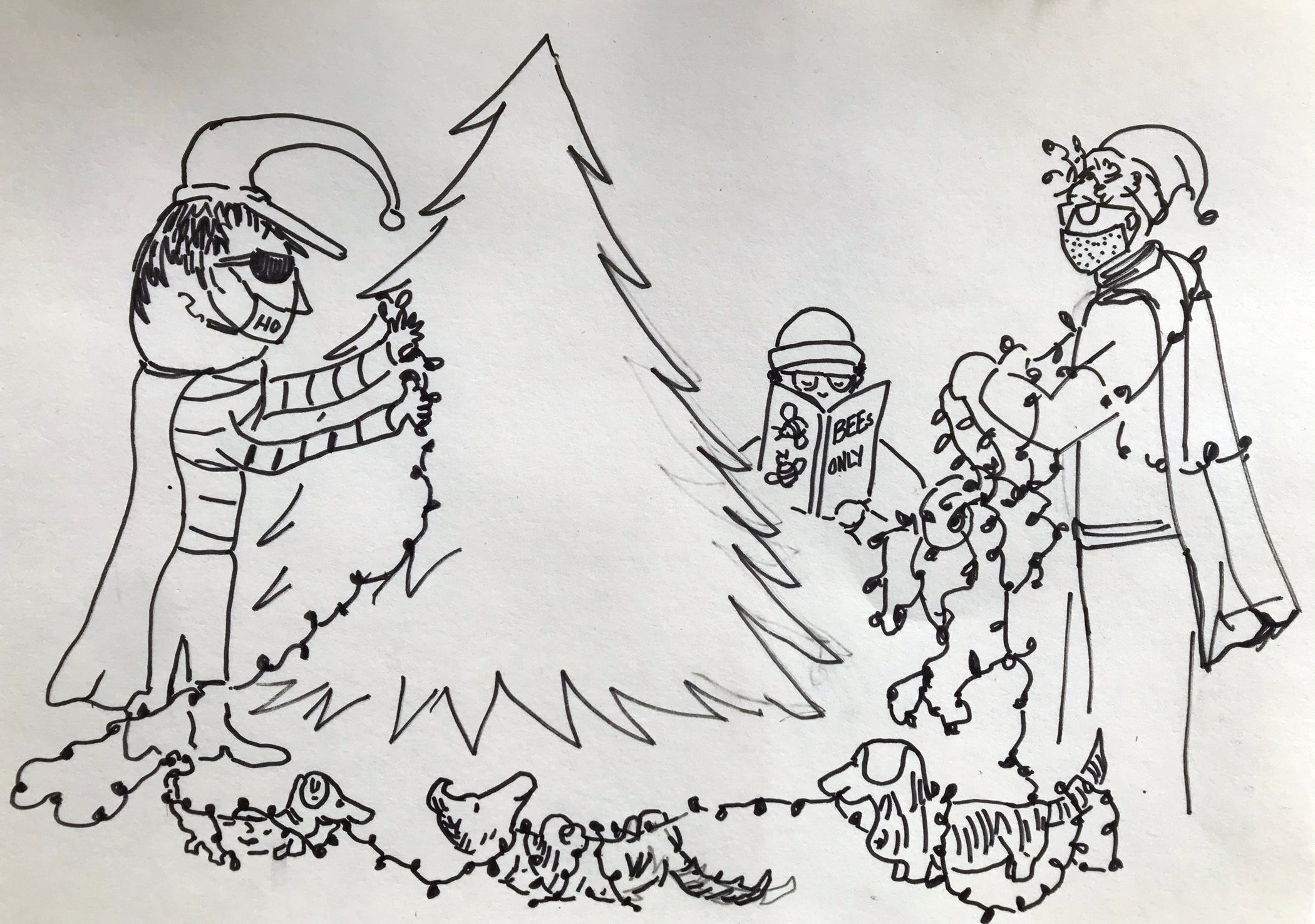
There is another way in which Jane and I work well together. We both believe the work is not finished until we put it out into the world. Somehow, someway, whether it is through an art gallery or show for Jane, or an open mic, book, or Substack for me, the collaboration completes itself when, and only when, it is shared. We believe that art, particularly collaborative art, comes with a final design, and that is to uplift and inspire. This can only happen when you let it go. The Christmas card above, done the first year of Covid, was sent to dozens of friends and family. More people received this card from me than on any other of the previous fifty Christmases I sent out cards.
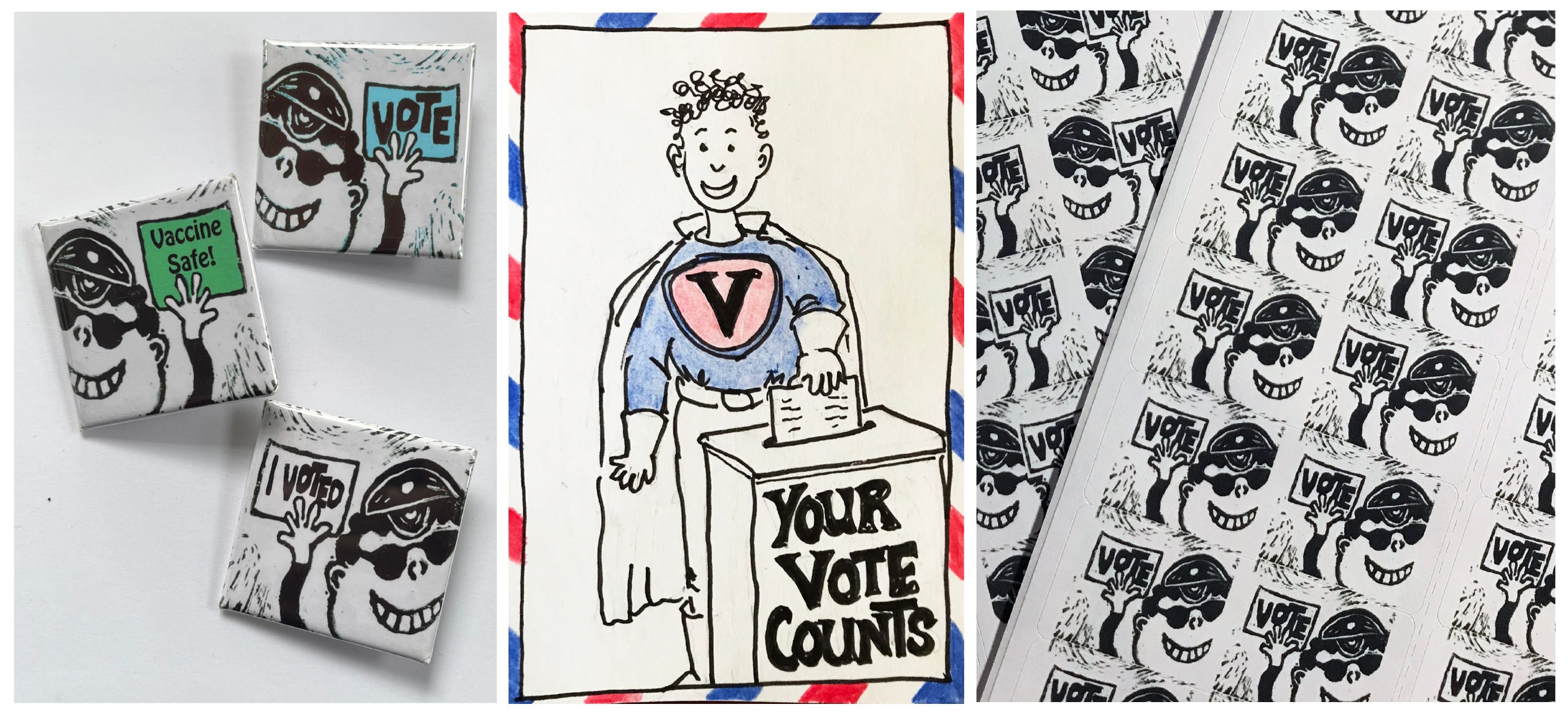
The illustrations below show some of the ways Bubba and Eliza appeared as persuasive elements when the time finally arrived to elect a new president. Now, in this second reign of terror, I wrote this piece to remind myself how we made it through the first one.
I hope you, too, will consider how to continue to create joy and laughter in your lives as we do the hard work to take care of one another, look out for those who cannot protect themselves, and stand up to those who would exert what they see as their power over us. Shared creativity keeps us sane as we put our shoulders to the grindstone of justice. That wheel may turn slowly, but oh, it grinds so fine.
We have the inner resources that can lift us up and prevent despair. This is an important asset when it comes to overcoming tyranny. We can ease the tension by being creative together, in collaboration. If I can do it, I promise, you can, too. We don’t give up our personal right to laugh and smile, the human right to experience pleasure, the individual right to create something new out of thin air, and the first amendment right to use it for the common good. In this way, we rise, friends. We rise.
Respect and gratitude to Jane Voorhees for both her inspiration and her help in getting this post out. It, too, is a collaboration. As are you, dear readers, subscribers and monetary contributors to my Substack. I cannot thank you enough.
Feel free to share how you are collaborating and creating your way through these uncertain times in the comments.
Time for a sequel set of cartoons!
Great graphics, great write